


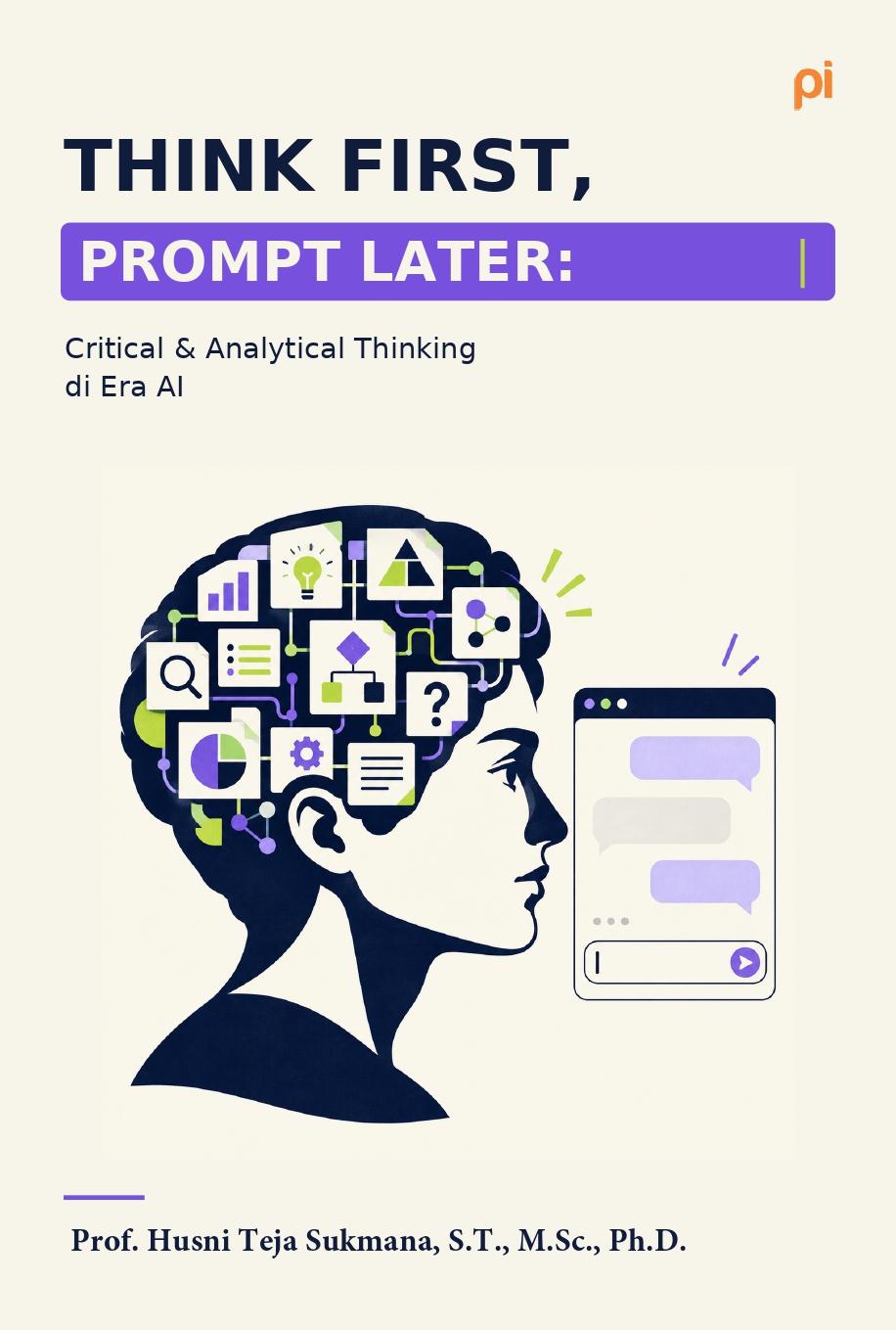
Buku ini membahas pentingnya kemampuan berpikir kritis dan analitis dalam memanfaatkan kecerdasan buatan (AI) secara efektif, sadar, dan bertanggung jawab. Buku ini menguraikan dasar-dasar penalaran, analisis masalah, evaluasi informasi, pengenalan bias dan kekeliruan logika, serta penyusunan prompt yang tepat. Pembaca juga diajak untuk memeriksa keakuratan informasi, menilai bukti, dan memahami keterbatasan jawaban AI sebelum menggunakannya dalam konteks akademik maupun profesional. Buku ini menegaskan bahwa AI berperan sebagai alat bantu, sedangkan manusia tetap bertanggung jawab atas proses berpikir, pengambilan keputusan, dan penggunaan informasi secara etis
Elder, L., & Paul, R. (2010, Oktober). Universal intellectual standards. Foundation for Critical Thinking. https://www.criticalthinking.org/pages/universal.intellectual-standard/527
Paul, R., & Elder, L. (1997, April). The elements of reasoning and the intellectual standards. Foundation for Critical Thinking. https://www.criticalthinking.org/pages/index-of-articles/the-elements-of-reasoning-and-the-intellectual-standards/480
Ramoo, D. (2025). Critical thinking. Thompson Rivers University Open Press. https://criticalthinking.pressbooks.tru.ca/
Tversky, A., & Kahneman, D. (1974). Judgment under uncertainty: Heuristics and biases. Science, 185(4157), 1124–1131. https://doi.org/10.1126/science.185.4157.1124
Van Cleave, M. J. (n.d.). Introduction to logic and critical thinking (Version 2.0).
Amer, A. (2005). Analytical thinking. Center for Advancement of Postgraduate Studies and Research in Engineering Sciences, Faculty of Engineering, Cairo University.
Heuer, R. J., Jr. (1999). Psychology of intelligence analysis. Center for the Study of Intelligence, Central Intelligence Agency. https://www.cia.gov/resources/csi/books-monographs/psychology-of-intelligence-analysis-2/
Spielman, R. M., Jenkins, W. J., & Lovett, M. D. (2020). Psychology 2e. OpenStax. https://openstax.org/details/books/psychology-2e
Grizzle, A., Wilson, C., Tuazon, R., Cheung, C. K., Lau, J., Fischer, R., Gordon, D., Akyempong, K., Singh, J., Carr, P. R., Stewart, K., Tayie, S., Suraj, O., Jaakkola, M., Thésée, G., Gu, C., Pascal, A. M. B., & Alain, Z. F. P. (2021). Media and information literate citizens: Think critically, click wisely! Media & information literacy curriculum for educators & learners. UNESCO. https://unesdoc.unesco.org/ark:/48223/pf0000377068
Miao, F., & Holmes, W. (2023). Guidance for generative AI in education and research. UNESCO. https://doi.org/10.54675/EWZM9535
Bailin, S., & Siegel, H. (2003). Critical thinking. N. Blake, P. Smeyers, R. Smith, P. Standish.
Haber, J. (2020). Critical thinking. MIT Press.
Anthonysamy, L., Sugendran, P., Wei, L. O., & Hoon, T. S. (2024). An improved metacognitive competency framework to inculcate analytical thinking among university students. Education and Information Technologies, 29(17), 22475-22497.

This work is licensed under a Creative Commons Attribution-NonCommercial-ShareAlike 4.0 International License.


