


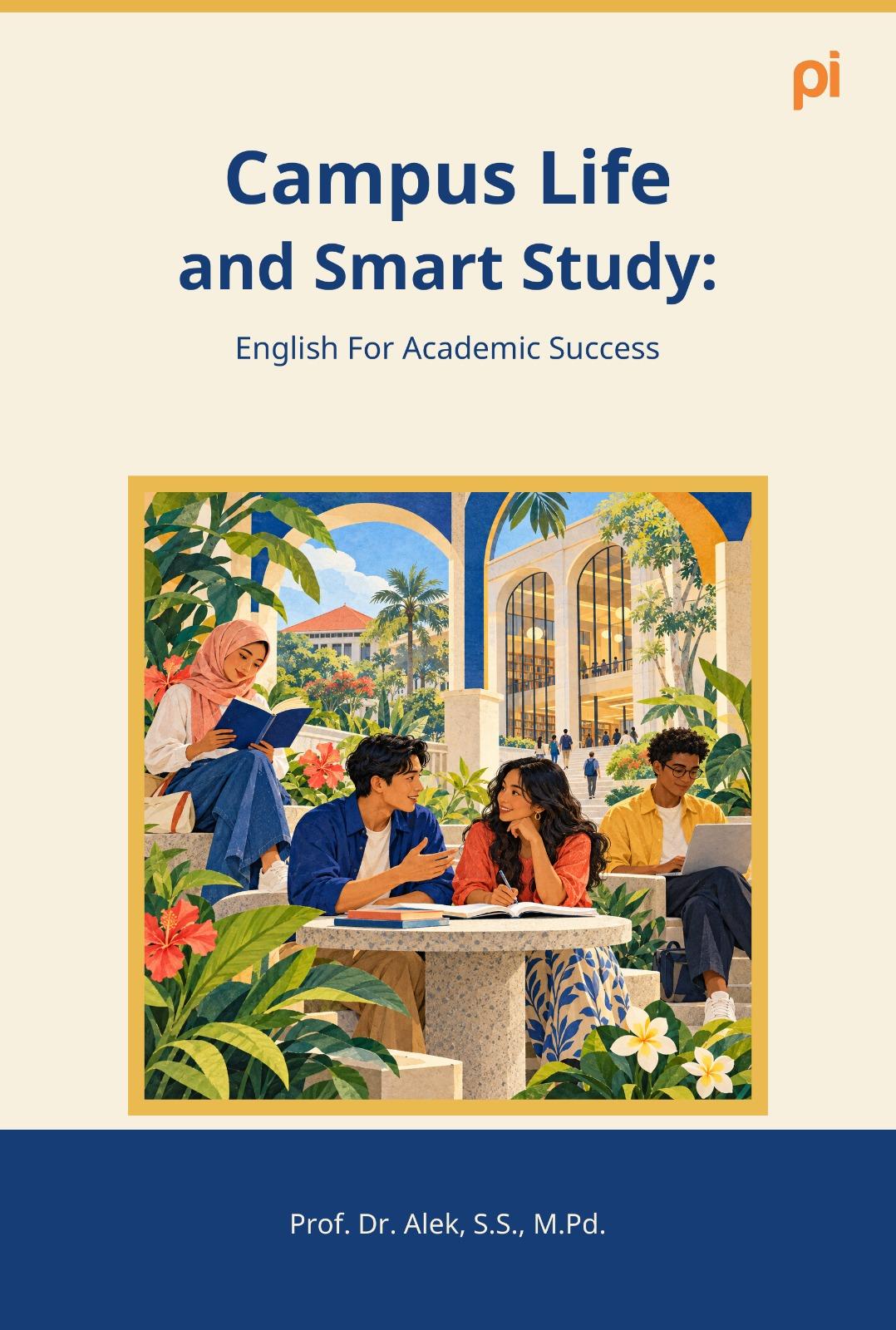
Buku ini membahas pengembangan keterampilan bahasa Inggris melalui konteks kehidupan kampus dan strategi belajar efektif. Buku ini mengintegrasikan keterampilan menyimak, berbicara, membaca, dan menulis dengan penguasaan tata bahasa serta kosakata akademik. Materinya mencakup komunikasi di lingkungan universitas, interaksi sosial, partisipasi dalam kegiatan kampus, pengelolaan waktu, penetapan prioritas, penyusunan tujuan akademik, dan penggunaan teknologi pembelajaran secara bertanggung jawab. Melalui berbagai latihan dan kegiatan reflektif, buku ini membantu mahasiswa meningkatkan kemampuan berbahasa Inggris sekaligus mengembangkan kemandirian, kedisiplinan, dan tanggung jawab dalam belajar. Buku ini dapat menjadi panduan untuk mendukung keberhasilan akademik dan mempersiapkan mahasiswa menghadapi berbagai tantangan di lingkungan perguruan tinggi.
Adair, J. (2009). Effective time management: How to save time and spend it wisely. Pan Macmillan.
Ahn, M. Y., & Davis, H. H. (2020). Four domains of students’ sense of belonging to university. Studies in Higher Education, 45(3), 622–634. https://doi.org/10.1080/03075079.2018.1564902
Allen, K.-A., Slaten, C., Hong, S., Ma, L., Craig, H., May, F., & Counted,
V. (2024). Belonging in higher education: A twenty year systematic review. Journal of University Teaching and Learning Practice, 21(5), 1–55. https://doi.org/10.53761/s2he6n66
Alvarez Sainz, M., Ferrero, A. M., & Ugidos, A. (2019). Time management: skills to learn and put into practice. Education+ Training, 61(5), 635-648.
Azar, B. S., Koch, R. S., Windows, X. P., & Flash, M. S. (2007). Fundamentals of English Grammar: Interactive. Longman.
Dodd, A. L., Punton, G., McLaren, J. M. A., Sillence, E., & Byrom, N. (2024). How can the university environment support student quality of life? A novel conceptual model. Education Sciences, 14(5), 547.
Gabriel, K. F. (2023). Teaching unprepared students: Strategies for promoting success and retention in higher education.
Grigsby, M. (2014). College life through the eyes of students. State University of New York Press.
Horowitz, H. L. (2013). Campus life. Knopf.
Nunn, L. M. (2021). College belonging: How first-year and first-generation students navigate campus life. Rutgers University Press.
Sidelinger, R. J., Frisby, B. N., & Heisler, J. (2016). Students' out of the classroom communication with instructors and campus services: Exploring social integration and academic involvement. Learning and Individual Differences, 47, 167–171. https://www.sciencedirect.com/science/article/abs/pii/S104160801 6300218
Stage, F. K. (1989). Reciprocal effects between the academic and social integration of college students. Research in Higher Education, 30, 517–530. https://doi.org/10.1007/BF00992201
Valente, S., Dominguez-Lara, S., & Lourenço, A. (2024). Planning time management in school activities and relation to procrastination: A study for educational sustainability. Sustainability, 16(16), 6883
Vanden Wyngaerd, G. (2008). Simple tense. In The function of function words and functional categories (pp. 187-215). John Benjamins Publishing Company.
Van den Berg, G., & Du Plessis, E. (2023). ChatGPT and generative AI: Possibilities for its contribution to lesson planning, critical thinking and openness in teacher education. Education Sciences, 13(10), 998.
Wolters, C. A., & Brady, A. C. (2021). College students’ time management: A self-regulated learning perspective. Educational psychology review, 33(4), 1319-1351

This work is licensed under a Creative Commons Attribution-NonCommercial-ShareAlike 4.0 International License.


