


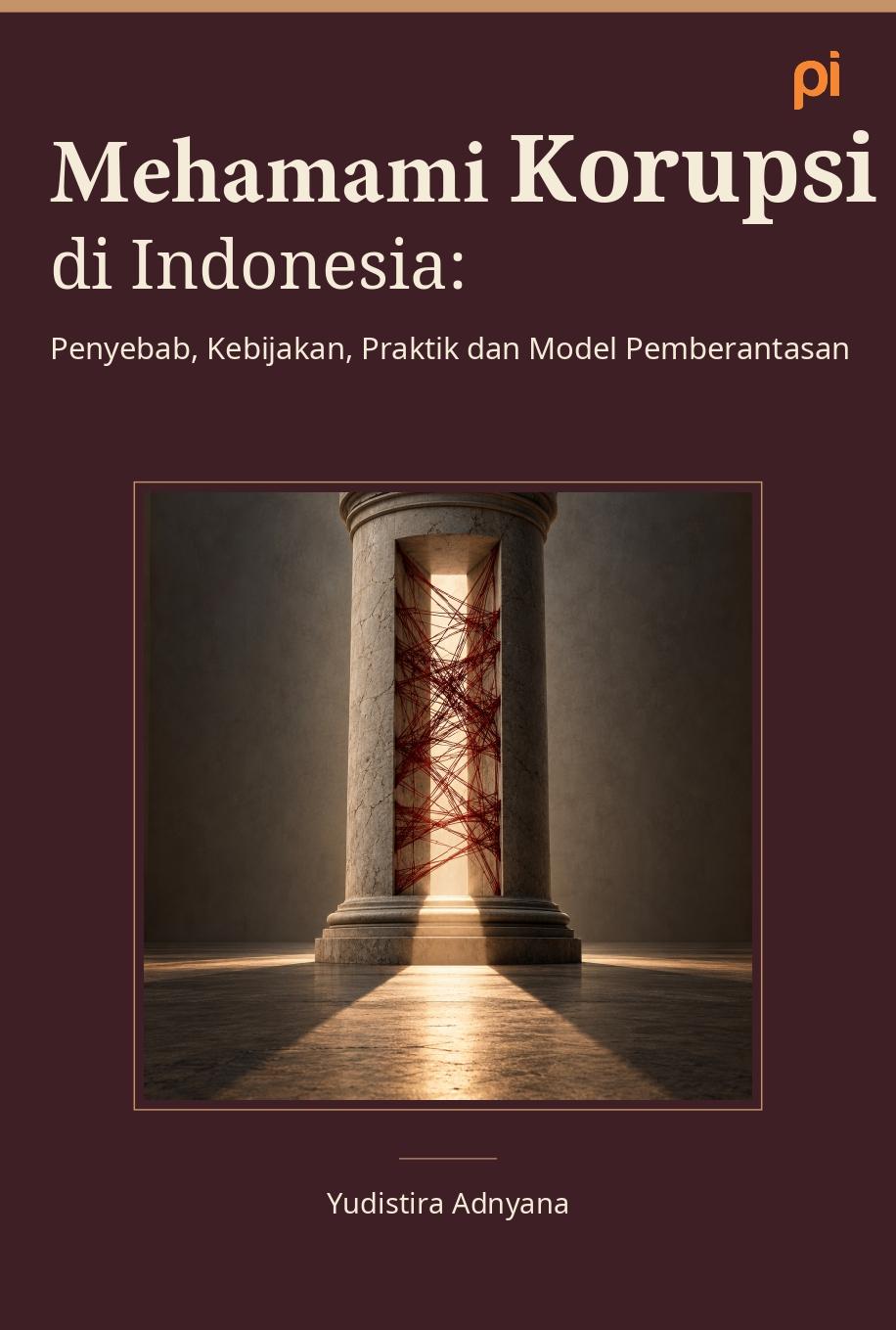
Buku ini membahas korupsi sebagai persoalan struktural dan kelembagaan yang berdampak terhadap demokrasi, perekonomian, pembangunan, dan kesejahteraan masyarakat. Pembahasan mencakup konsep, teori, sejarah, faktor penyebab, bentuk-bentuk korupsi, kerangka hukum, serta peran lembaga penegak hukum dan pengawasan. Buku ini juga menguraikan strategi pencegahan melalui digitalisasi, pendidikan integritas, penegakan hukum, dan penguatan tata kelola pemerintahan. Dengan pendekatan multidisiplin, buku ini diharapkan dapat menjadi referensi bagi mahasiswa, akademisi, praktisi hukum, dan pembuat kebijakan dalam memahami kompleksitas korupsi serta merumuskan upaya pemberantasan yang efektif, adil, dan berkelanjutan demi mewujudkan Indonesia yang berintegritas.
• Abadiyah, B. A. S., Zainal, V. R., & Hakim, A. (2025). Optimization of the role of the Corruption Eradication Commission in the efforts of corruption prevention and eradication. Journal of Law, Politic and Humanities, 5(3), 1301–1314. https://doi.org/10.38035/jlph.v5i3.1301
• Andersson, S., & Heywood, P. (2009). Anti-corruption as a risk to democracy: On the unintended consequences of international anti-corruption campaigns. In L. de Sousa, P. Larmour, & B. Hindess (Eds.), Governments, NGOs and anti-corruption: The new integrity warriors (pp. 33–50). Routledge.
• Antigua Observer. (2019, August 28). Report suggests A&B needs to strengthen Integrity Commission. Antigua Observer. https://antiguaobserver.com/report-suggests-ab-needs-to-strengthen-integrity-commission/
• Arndt, H. W. (1971). Banking in hyperinflation and stabilization. In B. Glassburner (Ed.), The economy of Indonesia: Selected readings (pp. 359–395). Cornell University Press.
• Asshiddiqie, J. (2006). Pengantar ilmu hukum tata negara. Sekretariat Jenderal dan Kepaniteraan Mahkamah Konstitusi RI.
• Badan Pusat Statistik. (2023). Indeks Perilaku Anti Korupsi Indonesia 2023. BPS-Statistics Indonesia.
• Bak, M. (2019). Overview of corruption and anti-corruption in Antigua and Barbuda, Barbados, Dominica, Guyana, Jamaica, St Lucia, and Trinidad and Tobago (U4 Helpdesk Answer 2019:13). Transparency International & U4 Anti-Corruption Resource Centre. http://www.jstor.org/stable/resrep20499
• Basel Institute on Governance. (2023). Features. In 2022 Annual report (pp. 8–33). Basel Institute on Governance. https://www.jstor.org/stable/resrep51357.5
• Bauhr, M., & Grimes, M. (2014). Indignation or resignation: The implications of transparency for societal accountability. Governance, 27(2), 291–320. https://doi.org/10.1111/gove.12033
• Becker, G. S. (1968). Crime and punishment: An economic approach. Journal of Political Economy, 76(2), 169–217. https://doi.org/10.1086/259394
• Besley, T., & McLaren, J. (1993). Taxes and bribery: The role of wage incentives. The Economic Journal, 103(416), 119–141. https://doi.org/10.2307/2234340
• Blundo, G., & Olivier de Sardan, J.-P. (Eds.). (2006). Everyday corruption and the state: Citizens and public officials in Africa. Zed Books.
• Boston, J., Martin, J., Pallot, J., & Walsh, P. (1996). Public management: The New Zealand model. Oxford University Press.
• Boxer, C. R. (1965). The Dutch seaborne empire 1600–1800. Hutchinson.
• Bratsis, P. (2003). The construction of corruption or: Rules of separation and illusions of purity in bourgeois societies. Social Text, 21(4), 9–33. https://doi.org/10.1215/01642472-21-4_77-9
• Bratton, M., & van de Walle, N. (1997). Democratic experiments in Africa: Regime transitions in comparative perspective. Cambridge University Press.
• Brown, E., & Cloke, J. (2004). Neoliberal reform, governance and corruption in the South: Assessing the international anti-corruption crusade. Antipode, 36(2), 272–294. https://doi.org/10.1111/j.1467-8330.2004.00406.x
• Brunetti, A., & Weder, B. (2003). A free press is bad news for corruption. Journal of Public Economics, 87(7–8), 1801–1824. https://doi.org/10.1016/S0047-2727(01)00186-4
• Buchanan, J. M. (1980). Rent seeking and profit seeking. In J. M. Buchanan, R. D. Tollison, & G. Tullock (Eds.), Toward a theory of the rent-seeking society (pp. 3–15). Texas A&M University Press.
• Campbell, J. W., & Danar, O. R. (2025). Institutional independence, credible commitment, and anti-corruption reform failure in developing contexts: Three illustrative examples from Indonesia. Public Integrity, 27, 777–795. https://doi.org/10.1080/10999922.2025.2462294
• Christensen, J. (2007). Mirror, mirror on the wall, who’s the most corrupt of all? Tax Justice Network. http://www.taxjustice.net/cms/upload/pdf/0701_Mirror_Mirror_corruption.pdf
• Clammer, J. (2012). Corruption, development, chaos and social disorganisation: Sociological reflections on corruption and its social basis. In M. Barcham, B. Hindess, & P. Larmour (Eds.), Corruption: Expanding the focus (pp. 113–132). ANU Press. https://www.jstor.org/stable/j.ctt24hbwc.11

This work is licensed under a Creative Commons Attribution-NonCommercial-ShareAlike 4.0 International License.


