


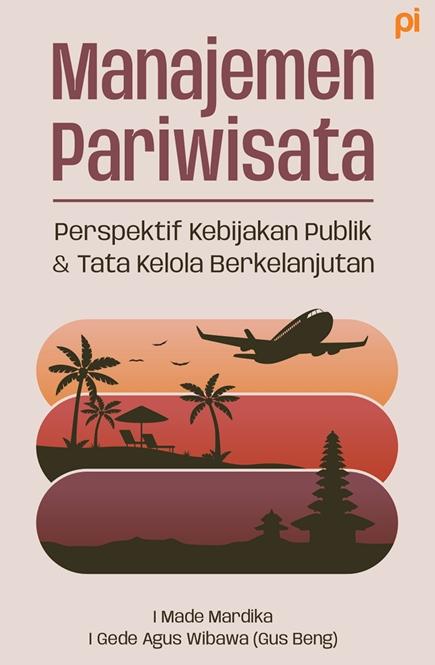
Buku ini mengeksplorasi pariwisata bukan sekadar sebagai sektor industri ekonomi, melainkan sebagai ranah kebijakan publik yang kompleks yang melibatkan pertarungan nilai dan kepentingan antar aktor. Buku ini membekali pembaca dengan landasan teoretis untuk memahami aset pariwisata sebagai barang publik dan sumber daya milik bersama yang rentan terhadap kegagalan pasar, sehingga memerlukan intervensi negara baik sebagai regulator maupun fasilitator. Melalui pembahasan yang komprehensif, penulis menguraikan evolusi paradigma dari pariwisata massal yang ekstraktif menuju pariwisata berkelanjutan, hingga mencapai konsep mutakhir pariwisata regeneratif yang berfokus pada pemulihan ekosistem dan pemberdayaan masyarakat lokal. Dengan mengintegrasikan isu-isu kontemporer seperti ekonomi sirkular, tata kelola digital, dan kebijakan berbasis nilai luhur, buku ini bertujuan mencetak administrator publik yang mampu mewujudkan tata kelola destinasi yang berkualitas, inklusif, dan tangguh secara ekologis.
Ansell, C., & Gash, A. (2008). Collaborative Governance in Theory and Practice. Journal of Public Administration Research and Theory, 18(4), 543–571. https://doi.org/10.1093/jopart/mum032
Barrett, R. (2013). The Values-Driven Organization: Unleashing Human Potential for Performance and Profit. Routledge.
Benedict, M. A., & McMahon, E. T. (2006). Green Infrastructure: Linking Landscapes and Communities. Island Press.
Blake, J. (2009). UNESCO's 2003 Convention on Intangible Cultural Heritage: The implications of community involvement in "safeguarding". In L. M. Smith & N. Akagawa (Eds.), Intangible Heritage (pp. 45-73). Routledge.
Bocken, N. M. P., de Pauw, I., Bakker, C., & van der Grinten, B. (2016). Product design and business model strategies for a circular economy. Journal of Industrial and Production Engineering, 33(5), 308-320. https://doi.org/10.1080/21681015.2016.1172124
Bolton, P. (2008). Green public procurement: A study of the use of environmental criteria in public procurement. European Commission, Directorate-General for the Environment.
Brammer, S., & Walker, H. (2011). Sustainable procurement in the public sector: An international comparative study. International Journal of Operations & Production Management, 31(4), 452-476. https://doi.org/10.1108/01443571111119551
Bramwell, B., & Lane, B. (2000). Tourism Collaboration and Partnerships: Politics, Practice and Sustainability. Channel View Publications.
Bressers, H., & O'Toole, L. J. (2005). The selection of policy instruments: A network-based perspective. Journal of Public Policy, 25(2), 177-200.
Brous, P., Janssen, M., & Herder, P. (2020). The dual effects of the Internet of Things (IoT): A systematic review of the benefits and risks of IoT. International Journal of Information Management, 51, 101952. https://doi.org/10.1016/j.ijinfomgt.2019.05.008
Buchanan, J. M. (1988). Market failure and government failure. In The New Palgrave Dictionary of Economics. Palgrave Macmillan.

This work is licensed under a Creative Commons Attribution-NonCommercial-ShareAlike 4.0 International License.


