


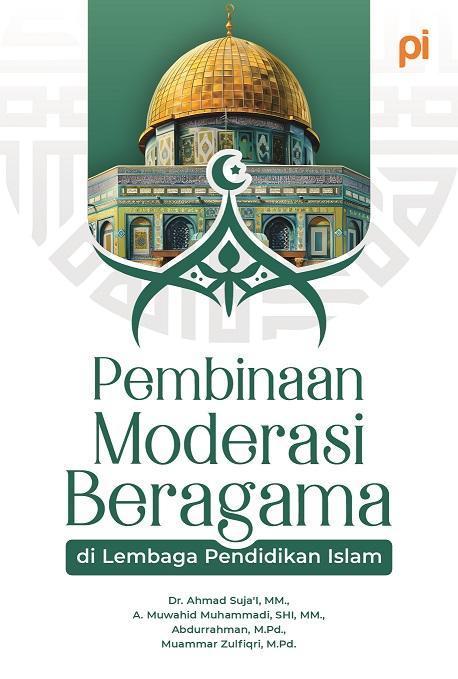
Buku ini membahas tentang pentingnya pembinaan moderasi beragama di lingkungan lembaga pendidikan Islam. Moderasi beragama adalah sikap tengah, tidak ekstrem kiri maupun kanan, dalam memahami dan mengamalkan ajaran agama. Sikap moderat ini sangat penting ditanamkan kepada generasi muda, khususnya di lembaga pendidikan Islam, agar mereka dapat menjadi pribadi yang seimbang, toleran, dan santun dalam beragama.
Buku ini terdiri dari tujuh bab yang mengupas secara komprehensif mengenai konsep moderasi beragama, pembinaan moderasi beragama, faktor-faktor yang mempengaruhinya, serta strategi dan implementasi pembinaan moderasi beragama di lembaga pendidikan Islam. Melalui buku ini, diharapkan dapat memberikan pemahaman, inspirasi, dan praktik terbaik bagi seluruh pihak yang berkepentingan dalam upaya mewujudkan generasi muda yang moderat, toleran, dan berkarakter Islami.
Books
Abduh, M. (1974). Risalah Al-Tawhid. Dar al-Fikr.
Abdullah, A. (2005). Pendidikan Agama Era Multikultural Multireligius. PSAP Muhammadiyah.
Al-Qaradawi, Y. (1998). Al-Khitab al-Islami bayna al-Intilaf wal-Jumud. Dar al-Shorouk.
Al-Qaradawi, Y. (2011). Kalimat fi al-Wasathiyyah al-Islamiyyah wa Ma’alimuha. Dar al-Syuruq.
Ali, M. (1998). Ilmu Perbandingan Agama di Indonesia. Mizan.
Armstrong, K. (2014). Fields of Blood: Religion and the History of Violence. Alfred A. Knopf.
Azra, A. (2006). Islam in the Indonesian World: An Account of Institutional Formation. Mizan.
Azra, A. (2020a). Indonesian Islamic Education in a Global Era. In R. Hefner (Ed.), Routledge Handbook of Contemporary Indonesia. Routledge.
Azra, A. (2020b). Moderasi Islam di Indonesia: Dari Ajaran, Ibadah, hingga Perilaku. Kencana.
Banks, J. A. (2015). Cultural Diversity and Education: Foundations, Curriculum, and Teaching. Routledge.
Bar-Tal, D., & Rosen, Y. (2009). Peace Education in Societies Involved in Intractable Conflicts: Direct and Indirect Models. Review of Educational Research, 79(2), 557–575.
Bardach, E., & Patashnik, E. M. (2020). A practical guide for policy analysis: The eightfold path to more effective problem solving (6th ed.). CQ Press.
Bennett, M. J. (2017). Developmental Model of Intercultural Sensitivity (Y. Y. Kim (ed.)). Wiley.
Bronfenbrenner, U. (1979). The Ecology of Human Development: Experiments by Nature and Design. Harvard University Press.
Creswell, J. W. (2014). Research Design: Qualitative, Quantitative, and Mixed Methods Approaches (IV). SAGE Publications.
Darling-Hammond, L., Hyler, M. E., & Gardner, M. (2017). Effective Teacher Professional Development. Learning Policy Institute.
Deming, W. E. (1986). Out of the Crisis. MIT Press.
Dewey, J. (1938). Experience and Education. Macmillan.
Erikson, E. H. (1968). Identity: Youth and Crisis. Norton.
Esposito, J. L. (2002). Unholy War: Terror in the Name of Islam. Oxford University Press.
Fowler, J. (1981). Stages of Faith: The Psychology of Human Development and the Quest for Meaning. Harper & Row.
Freire, P. (1970). Pedagogy of the Oppressed. Continuum.
Hefner, R. W. (2016b). Schooling Islam: The Culture and Politics of Modern Muslim Education. Princeton University Press.
Hefner, R. W. (2020). Islam and Democracy in Indonesia: Tolerance without Liberalism. Cambridge University Press.
Institute, M. (2017). Laporan Penelitian: Pemetaan Ideologi Radikal di Sekolah dan Perguruan Tinggi. Maarif Institute.
J. A. Banks. (2018). Cultural Diversity and Education: Foundations, Curriculum, and Teaching. Routledge.
Jakarta, P. U. (2018). Hasil Survei PPIM 2018: Pelita yang Meredup: Potret Keberagamaan Guru Indonesia. PPIM UIN Jakarta.
Jeynes, W. H. (2015). A Meta-Analysis on the Relationship Between Student Religiosity and Academic Achievement. Ducation and Urban Society, 47(2), 186–204.
John W. Creswell, J. D. C. (2017). Research Design: Qualitative, Quantitative, and Mixed Methods Approaches. SAGE Publications.
Joyce, B., & Weil, M. (2003). Models of Teaching (7th ed.). Allyn and Bacon.
Kaufman, R. A. (1993). Needs Assessment: A User’s Guide. Educational Technology Publications.
Lickona, T. (1991). Educating for Character: How Our Schools Can Teach Respect and Responsibility. Bantam Books.
Lukens-Bull, R. (2013). Islamic Higher Education in Indonesia: Continuity and Conflict. Palgrave Macmillan.
Madjid, N. (1998a). Dialog Keterbukaan: Artikulasi Nilai Islam dalam Wacana Sosial Politik Kontemporer. Paramadina.
Madjid, N. (1998b). Kehidupan dan Moderasi dalam Beragama. Paramadina.
Marcia, J. E., Waterman, A. S., Matteson, D. R., Archer, S. L., & Orlofsky, J. L. (2012). Ego Identity: A Handbook for Psychosocial Research. Springer Science & Business Media.
Mas’ud, A. (2007). Menggagas Format Pendidikan Nondikotomik: Humanisme Religius sebagai Paradigma Pendidikan Islam. Gama Media.
Masnur, M. (2011). Pendidikan Karakter: Menjawab Tantangan Krisis Multidimensional. Bumi Aksara.
Menchik, J. (2016). Islam and Democracy in Indonesia: Tolerance without Liberalism. Cambridge University Press.
Nussbaum, M. C. (2018). The Cosmopolitan Tradition: A Noble but Flawed Ideal. Harvard University Press.
Patton, M. Q. (2008). Utilization-Focused Evaluation (4th ed.). SAGE Publications.
Pohl, F. (2015). Islamic Education and the Public Sphere: Today’s Pesantren in Indonesia. Waxmann Verlag.
Psacharopoulos, G., & Woodhall, M. (1985). Education for Development: An Analysis of Investment Choices. Oxford University Press.
Putnam, R. D. (2000). Bowling Alone: The Collapse and Revival of American Community. Simon and Schuster.
Rahman, F. (1982). Islam and Modernity: Transformation of an Intellectual Tradition. University of Chicago Press.
Rahman, F. A., Suharto, T., & Zamroni, Z. (2022). The Development of Religious Tolerance Among Indonesian Students: A Longitudinal Study. Journal of Moral Education, 51(2), 217–233.
Ramadan, T. (2004). Western Muslims and the Future of Islam. Oxford University Press.
Ramadan, T. (2009). Radical Reform: Islamic Ethics and Liberation. Oxford University Press.
RI, K. A. (2019). Moderasi Beragama. Badan Litbang dan Diklat Kementerian Agama RI.
Rue, L. W., & Byars, L. L. (2000). Management: Skills and Application (9th ed.). Irwin McGraw-Hill.
Sachedina, A. (2018). The Islamic Roots of Democratic Pluralism. Oxford University Press.
Sacks, J. (2002). The Dignity of Difference: How to Avoid the Clash of Civilizations. Continuum.
Schein, E. H. (2010). Organizational Culture and Leadership (4th ed.). Jossey-Bass.
Schön, D. (1983). The Reflective Practitioner: How Professionals Think in Action. Basic Books.
Scriven, M. (1967). The Methodology of Evaluation. In R. W. Tyler, R. M. Gagne, & M. Scriven (Eds.), Perspectives of Curriculum Evaluation. Chicago: Rand McNally.
Sen, A. (1999). Development as Freedom. Oxford University Press.
Sen, A. (2006). Identity and Violence: The Illusion of Destiny. W.W. Norton & Company.
Shihab, M. Q. (2019). Wasathiyyah: Wawasan Islam tentang Moderasi Beragama. Lentera Hati.
Slavin, R. E. (2011). Cooperative Learning: Theory, Research, and Practice. Allyn & Bacon.
Stufflebeam, D. L. (2003). The CIPP Model for Evaluation. In T. Kellaghan & D. L. Stufflebeam (Eds.). Kluwer Academic Publishers.
Terry, G. R. (2010). Prinsip-prinsip Manajemen. (terj. J. Smith. D.F.M). Bumi Aksara.
Thaha, I. (2021). Dialogue and Conflict Resolution Skills Among Indonesian Islamic School Students. Peace and Conflict Studies, 28(1), 45–67.
Tibi, B. (2007). Islam’s Predicament with Modernity: Religious Reform and Cultural Change. Routledge.
Tyler, R. W. (1949). Basic Principles of Curriculum and Instruction. University of Chicago Press.
UNESCO. (2015). Global Citizenship Education: Topics and Learning Objectives. UNESCO.
Vygotsky, L. S. (1978). Mind in Society: The Development of Higher Psychological Processe. Harvard University Press.
Wahid, A. (1999). Islam dan Pluralisme: Keterbukaan dalam Tradisi. Wahid Foundation.
Wahid, A. (2006). Islamku Islam Anda Islam Kita: Agama Masyarakat Negara Demokrasi. The Wahid Institute.
Yin, R. K. (2014). Case study research: Design and methods (5th ed.). Sage Publication, inc.
Zarkasyi, H. F. (2018). Moderasi Islam: Antara Liberalisme dan Ekstremisme. Gema Insani.
Journals
Abdullah, A. (2017). Islamic Studies in Higher Education in Indonesia: Challenges, Impact and Prospects for Social Transformation. Al-Jami’ah: Journal of Islamic Studies, 55(2), 391–426.
Abdullah, A. G. (2019). The role of Islamic boarding school in the development of religious moderation in Indonesia. Journal of Education and Practice, 10(8), 1–6.
Abdurrohman, A., & Syamsuddin, M. (2020). The Effect of Religious Moderation Education on Students’ Understanding of Islamic Concepts. Journal of Islamic Studies, 31(2), 245–268.
Ahmed, I. (2018). Moderation in Islamic Education: The Malaysian Experience. Journal of Education and Training Studies, 6(11), 87–92.
Deardorff, D. K. (2006). dentification and Assessment of Intercultural Competence as a Student Outcome of Internationalization. Journal of Studies in International Education, 10(3), 241–266.
Doran, G. T. (1981). There’s a S.M.A.R.T. Way to Write Management’s Goals and Objectives. Management Review, 70(11), 35–36.
Epstein, J. L. (2010). School/Family/Community Partnerships: Caring for the Children We Share. Phi Delta Kappan, 92(3), 81–96.
Farihah, A. Z. & N. (2018). The Role of Teachers in Promoting Religious Moderation in Islamic Schools. Journal of Education and Practice, 9(4), 47–54.
Hasan, M. A. (2018). Integrating Wasatiyyah (Moderation) in Islamic Education Curriculum. Journal of Education and Learning, 12(3), 390–397.
Hefner, R. W. (2016a). Muslim Education and the Challenge of Pluralism: Southeast Asian Perspectives. Journal of Islamic Studies, 27(1), 1–20.
Kamaruzzaman, A. I. (2017). Religious Moderation in the Islamic Education Curriculum in Southeast Asia: A Comparative Study. Journal of Southeast Asian Studies, 22(1), 47–62.
Massoni, E. (2011). Positive Effects of Extra Curricular Activities on Students. ESSAI, 9(1), 84–87.
Masten, A. S. (2014). Global Perspectives on Resilience in Children and Youth. Child Development, 85(1), 6–20.
Menchik, J. (2021). The Role of Religious Education in Promoting Civic Engagement: Evidence from Indonesia. Democratization, 28(1), 85–104.
Nurdiansyah, A. (2019). The Role of Islamic Education in Strengthening Religious Moderation in Indonesia. Journal of Education and Practice, 10(12), 87–94.
Pargament, K. I., & Mahoney, A. (2013). APA Handbook of Psychology, Religion, and Spirituality (Vol. 1) (E. P. Shafranske (ed.)). American Psychological Association.
Shihab, M. Q. (2015). Moderation in Islam: In Pursuit of Wasatiyyah. Journal of Indonesian Islam, 9(1), 1–20.
Siddique, M. A. B. (2017). Moderation in Islamic Education: A Comparative Study of the Approaches of Sheikh Muhammad Ghazali and Fazlur Rahman. Journal of Islamic Studies and Culture, 5(2), 89–100.
Wahid, D. (2016). Moderation in Islam: The Case of Nahdlatul Ulama in Indonesia. Journal of Indonesian Islam. Journal of Indonesian Islam, 10(1), 117–140.
Yusuf, M. R. & Y. Q. (2019). Promoting Religious Moderation Through Cooperative Learning in Islamic Education. Indonesian Journal of Islam and Muslim Societies, 9(2), 331–358.

This work is licensed under a Creative Commons Attribution-NonCommercial-ShareAlike 4.0 International License.


