


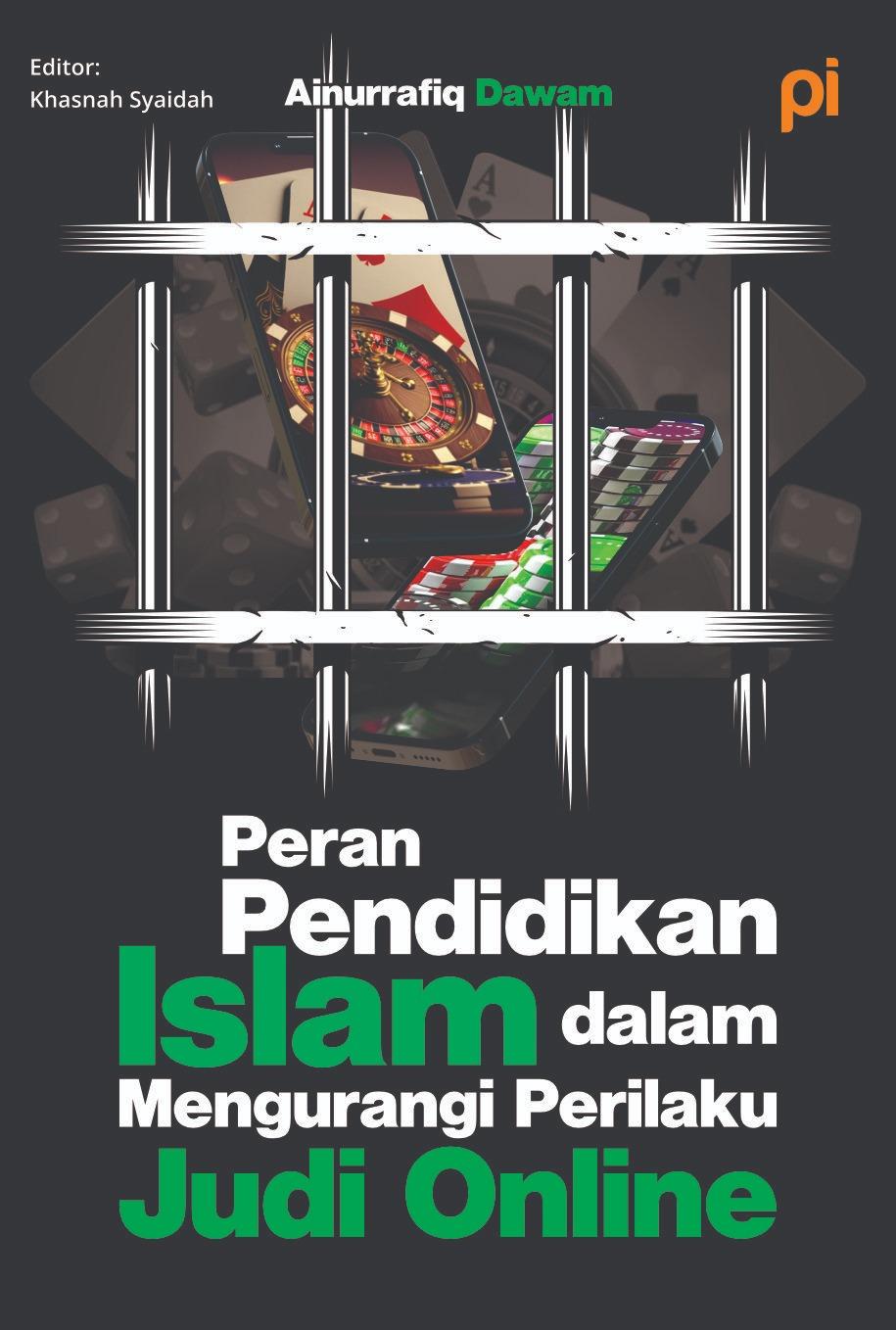
Pendidikan Islam memiliki peran penting dalam membentuk karakter dan akhlak seseorang. Melalui pendidikan yang berbasis nilai-nilai Islam, diharapkan generasi muda dapat memahami betapa pentingnya menjauhi perbuatan yang dilarang oleh agama, termasuk judi online. Buku ini berusaha menggali lebih dalam bagaimana pendidikan Islam dapat menjadi benteng yang kuat dalam melawan arus negatif judi online.
Buku ini hadir sebagai respon atas meningkatnya fenomena judi online yang meresahkan masyarakat, terutama di kalangan generasi muda. Judi online bukan hanya sebuah masalah ekonomi atau hukum, melainkan juga masalah moral dan spiritual yang memerlukan pendekatan komprehensif, salah satunya melalui pendidikan Islam.
Addiyansyah, W., & Rofi’ah. (2023). Kecanduan Judi Online Di Kalangan Remaja Desa Cilebut Barat. MANIFESTO: Jurnal Gagasan Komunikasi, Politik, Dan Budaya, 1(1).
Banks, J. (2017). Gambling, crime and society. In Gambling, Crime and Society. https://doi.org/10.1057/978-1-137-57994-2
Blaszczynski, A., & Nower, L. (2002). A pathways model of problem and pathological gambling. In Addiction (Vol. 97, Issue 5). https://doi.org/10.1046/j.1360-0443.2002.00015.x
Daniel, N., & Makdisi, G. (1984). The Rise of Colleges. Institutions of Learning in Islam and the West. Journal of the American Oriental Society, 104(3). https://doi.org/10.2307/601679
Fazrul, R. (1984). Islam and Modernity. Transformation of an Intellectual Tradition. Archives de Sciences Sociales Des Religions, 58(2).
Gainsbury, S. (2010). Response to the Productivity Commission Inquiry Report into Gambling: Online gaming and the Interactive Gambling Act. Gambling Research: Journal of the National Association for Gambling Studies (Australia), 22(2).
Gainsbury, S., & Blaszczynski, A. (2011). A systematic review of Internet-based therapy for the treatment of addictions. In Clinical Psychology Review (Vol. 31, Issue 3). https://doi.org/10.1016/j.cpr.2010.11.007
Gainsbury, S., Wood, R., Russell, A., Hing, N., & Blaszczynski, A. (2012). A digital revolution: Comparison of demographic profiles, attitudes and gambling behavior of Internet and non-Internet gamblers. Computers in Human Behavior, 28(4). https://doi.org/10.1016/j.chb.2012.02.024
Ghazali. (2023). Ihya ’ulum al-din. In Ihya ’ulum al-din. https://doi.org/10.1163/9789004662087
Griffiths, M. (2003). Internet Gambling: Issues, Concerns, and Recommendations. In Cyberpsychology and Behavior (Vol. 6, Issue 6). https://doi.org/10.1089/109493103322725333
Griffiths, M. D., & Parke, J. (2002). The social impact of Internet gambling. Social Science Computer Review, 20(3). https://doi.org/10.1177/08939302020003008
Halstead, J. M. (2004). An Islamic concept of education. Comparative Education, 40(4). https://doi.org/10.1080/0305006042000284510
Hidayatullah, Ach. T., Jalaludin, M., & Ahmad, A. Y. (2022). Sejarah Lembaga Pendidikan Islam ( Madrasah ) Dan. Jurnal Mahasiswa, 4(3).
Hing, N., Cherney, L., Blaszczynski, A., Gainsbury, S. M., & Lubman, D. I. (2014). Do advertising and promotions for online gambling increase gambling consumption? An exploratory study. International Gambling Studies, 14(3). https://doi.org/10.1080/14459795.2014.903989
Jai, A. M. E., Astuti, P., & Ahmad, G. A. (2020). Tinjauan Yuridis Terhadap Perbuatan Manipulasi Hasil Pertandingan Dalam Persepakbolaan Indonesia. Universitas Negeri Surabaya, 7(1).
King, D., Delfabbro, P., & Griffiths, M. (2010). Video game structural characteristics: A new psychological taxonomy. International Journal of Mental Health and Addiction, 8(1). https://doi.org/10.1007/s11469-009-9206-4
Letson, L. M. (2010). Pathological gambling: Promoting risk, provoking ruin. In Impulse Control Disorders. https://doi.org/10.1017/CBO9780511711930.007
Mariana, D., & Helmi, A. M. (2022). Madrasah Sebagai Lembaga Pendidikan Di Indonesia. Jurnal Pendidikan Tambusai, 6(1).
Nuryanto, A. (2022). Concept of Education in Islam. Internasional Journal of Islamic Religious, 1(1).
Parke, J., & Griffiths, M. (2006). The psychology of the fruit machine: The role of structural characteristics (revisited). In International Journal of Mental Health and Addiction (Vol. 4, Issue 2). https://doi.org/10.1007/s11469-006-9014-z
Przybylski, A. K., Weinstein, N., & Murayama, K. (2017). Internet gaming disorder: Investigating the clinical relevance of a new phenomenon. American Journal of Psychiatry, 174(3). https://doi.org/10.1176/appi.ajp.2016.16020224
Qazi, A., Hardaker, G., Ahmad, I. S., Darwich, M., Maitama, J. Z., & Dayani, A. (2021). The Role of Information Communication Technology in Elearning Environments: A Systematic Review. In IEEE Access (Vol. 9). https://doi.org/10.1109/ACCESS.2021.3067042
Rosenthal, F. (2007). Knowledge triumphant: The concept of knowledge in Medieval Islam. In Brill Classics in Islam (Vol. 2). https://doi.org/10.2307/600550
Salim, S. (2016). LEKTUR MODEREN SEJARAH PENDIDIKAN ISLAM DI INDONESIA. MIQOT: Jurnal Ilmu-Ilmu Keislaman, 40(1). https://doi.org/10.30821/miqot.v40i1.238
Smeaton, M., & Griffiths, M. (2004). Internet Gambling and Social Responsibility: An Exploratory Study. Cyberpsychology and Behavior, 7(1). https://doi.org/10.1089/109493104322820110
Universitas Islam An Nur Lampung. (2022). Judi dalam Islam: Pengertian, Unsur, Contoh, Akibat dan Hikmah Meninggalakannya. Https://An-Nur.Ac.Id/.
Wood, R. T. A., & Griffiths, M. D. (2007). Online guidance, advice, and support for problem gamblers and concerned relatives and friends: An evaluation of the GamAid pilot service. British Journal of Guidance and Counselling, 35(4). https://doi.org/10.1080/03069880701593540

This work is licensed under a Creative Commons Attribution-NonCommercial-ShareAlike 4.0 International License.


